
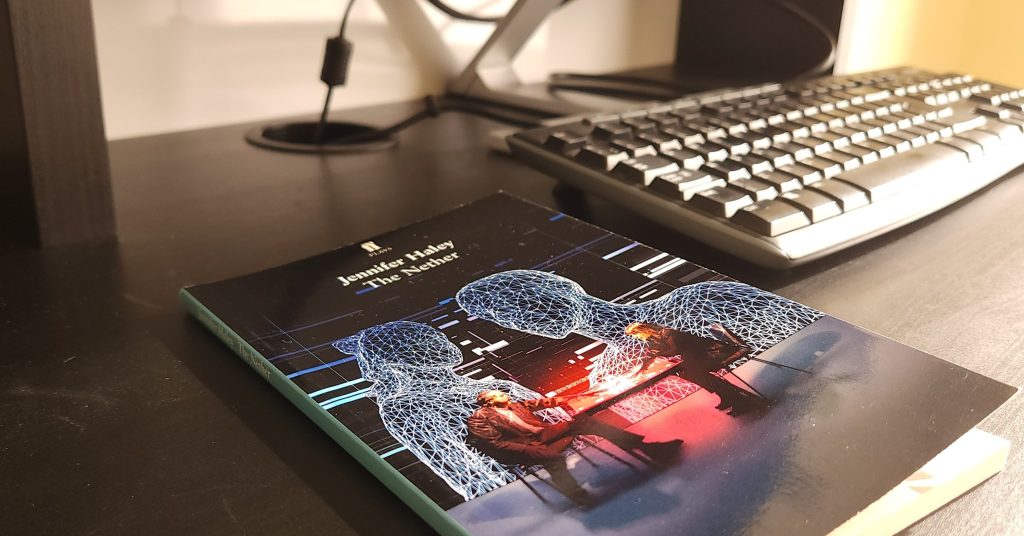
With a greater distance of time, Jennifer Haley’s 2013 play The Nether can live a little more freely than when it debuted. I think there is a tendency when a work of science fiction first appears (particularly those that are set, like The Nether, “soon”) to judge it on its short term predictive abilities and its resemblance to current technologies rather than its artistic merits. As Ursula K. Le Guin points out “science fiction is not predictive; it is descriptive. The future, in fiction, is a metaphor”. Untied from a particular moment in technological history the metaphors of the play increase in their power.
The Nether is a place of virtual reality rapidly taking the place of real world experiences as the world itself withers and dies. The majority of work and education occur in the Nether. As does “anything you want to know or do or think you might want to try.” In the opening scene of the play we meet the businessman Sims under interrogation by Detective Morris, an “in-world representative” of the investigative unit of the Nether. Sims created the Hideaway where behind the facade of a “beautifully rendered 1880’s Gothic Revival with a squeak in the top porch step” the horrific abuse of children is indulged in for pleasure and profit. This link between humanity’s advancement and its monstrosity is made explicit by Sims:
“Did you know porn drives technology? The first photographs? Porn. The first movies? Porn. The most popular content when the Nether was the internet? Porn. The urge, Detective – the urge – as long as we are sentient, you will never stamp that out.”
Scenes alternate between interrogation room and Hideaway, between accused and accuser. Also being investigated is Doyle, a “guest” of the Hideaway. Both Doyle and Sims have a particular attraction to Iris, a “shining little girl” of the Hideaway, as does a fourth character, Woodnut, a new guest of the Hideaway.
By putting technology and such horror on stage Haley sets herself a sizable challenge with many potential pitfalls. The worldbuilding has to be convincing within the constraints of the medium. The depiction of the worst of humanity has to avoid overwhelming the story without eliding the subject. With a taut focus and using the rhythms of crime drama to tell the story, Haley skillfully and successfully meets this challenge. The story developments feel earned and thematically consistent rather than sensationalist considering the subject matter at hand. This is theatre that challenges – author and audience – through story and character, not shock or sensationalism.
At the heart of the play is a wider, more profound interrogation than just that of technology’s development and impact on society. Technology is a symptom. What The Nether asks of the audience is to think; how do we deal with the worst elements of us, either practically or through art? These people exist and have always existed – so what do we do? As Sims’ refrain of a life free of consequence echoes ironically, the play is in effect a dramatisation of consequence. These things will always be with us because people are really, really messed up. The Hideaway mines the darkest recesses of what humanity is capable of, but also serves as a metaphor for all the ways in which we hide parts of ourselves. And there will always be consequences – promised technological libertarian utopias or not.
What is striking in re-reading the text is how one of the oldest storytelling mediums can be so appropriate for such a modern topic. The voyeuristic anonymity of an audience observing people and their avatars, characters there but not there, theatre as an agreed virtual reality. As Haley stated in an interview:
The very foundation of theatre is actors letting a new personality infiltrate their body—they put an avatar onstage. When people go online and play different characters, it becomes theatre. They’re living out other stories.
The play captures this fluid sense of human identity both structurally and thematically. What we assume is linear is not quite as clear by the play’s conclusion. The epilogue replays an earlier scene, but rather than the avatars seen previously we see it this time with characters as they really are, “what we are made of. The materials of the earth.” The dynamic shifts. The more I think about it the more haunting the last line of the play becomes. A gift for an actor, where the stress falls in the line can conclude or revise everything we’ve been watching. And for the reader the choice can change with every reading. We see the tragedy and horror of a misaligned existence and are left to decide which reality serves the individual, and society, better.

 The Read Through
Leave a comment