
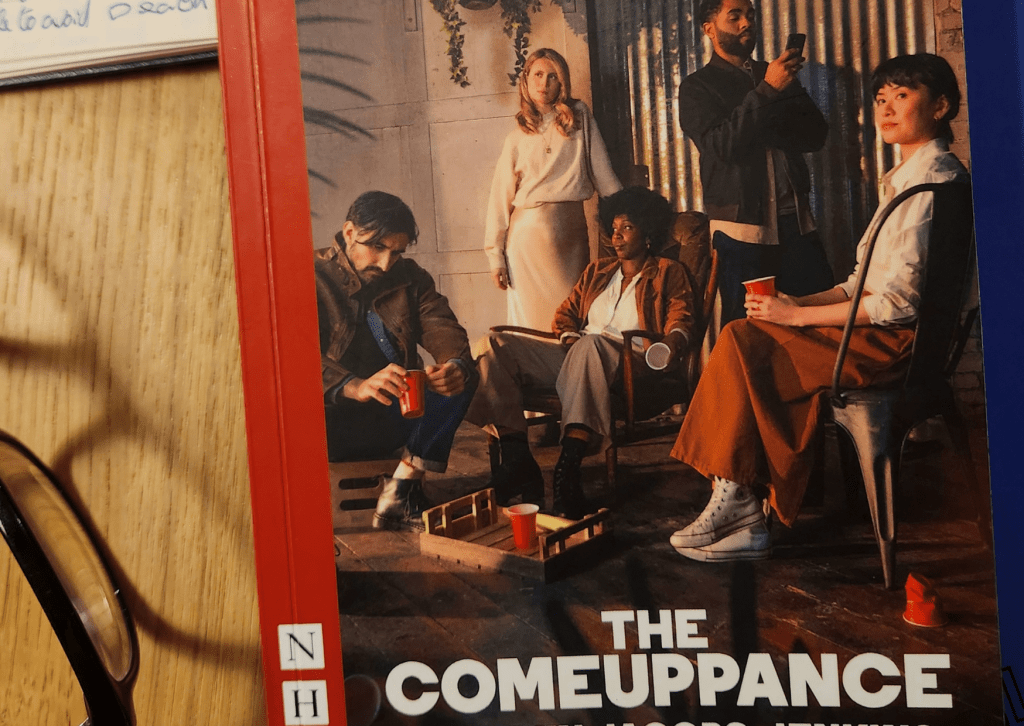
Warning: Here be spoilers. I like to write about all of a play and not avoid mentioning the ending. That’s the best bit.
I love a play that leaves me with an abiding image – a moment, a gesture – that encapsulates the connective moment of meaning between writer, actor and audience.
At the end of Brendan Jacob-Jenkins’ The Comeuppance old school friends Emilio and Ursula are alone on the porch of her house. (That powerful, transitionary American space. The house is the place of family, the porch the halfway zone of discovery between childhood and adulthood). The attempted 20th High School pre-reunion reunion has been generally disastrous. Long buried resentments and emotions of six friends resurface, facades drop, alcohol and weed are consumed. Ursula returns home from the actual reunion. Emilio has been left there to stew after berating his former friends, stranded on the porch after that perennial expression of technological anxiety, the dying phone battery, finally gives up the fight to stay charged.
They talk, reflect on time, meaning, the big stuff. Emilio plays Ursula mosquito tones – sounds that are:
“right on the edge of your hearing range, but only certain people of certain ages can hear certain ones, because as you get older and older, your range of hearing gets narrower and narrower
He asks her to
As she plays the sounds he says:
We just passed the edge of my hearing range.
Ursula can:
still hear something… I think…
The play ends.
Such a sad, beautiful summation of everything that has taken place in the play. For the previous two hours the characters have been trying to find, or fight, a way back to their old friends, old selves, old feelings that are “are in their twenties” now.
And as Emilio and Ursula find their point of silence the audience can become part of the process, listening for their own out of range moment. We have art that isn’t “tired of mimesis” as Emilio wearily mentions his abandonment of photography. And there is a seventh character in the play, who happens to be Death. Death inhabits each of the characters as he addresses the audience. He tells us that:
“Memory, as you know, is just a myth. life, the present, is its expression. The present is the best part – of all things
The play’s end is one of inevitability and perhaps acceptance that these things are all passing or gone. Both the futility of attempting to recreate the past and also the tragic beauty or even nobility of the attempt – the person who could hear those sounds long gone.
If they did even hear them in the first place.
The play is full of references to recreations, to simulacra. To recreations of recreations. There is the reunion itself, ostensibly a chance to reconnect with old friends but also a chance for everyone to feel “like they used to”. A limo is organised for the group to arrive ironically in, re-living something that was an imitation in the first place.
Emilio:
..in high school, every stupid prom, every homecoming, we were always randomly showing up in a limo like somehow it was a thing that people did in real life.Caitlin:
But we’re not teenagers anymore. We’re just adults showing up in a limo.
Facebook gives way to Instagram and AI lurks on the periphery to provide the next level of recreation of the real. Zoom steps in to simulate face to face interaction. There are instances of fake army training, fake fatherhood, fake boyfriends.
There is very much a feeling of state of the nation being explored. That nation being the past 20 years of United States – a nation that has a particular, and possibly peculiar, need to reiterate its own mythology with each new generation. Jan 6th, Columbine, Charlottesville, 9/11 are all viewed through the lens of the self proclaimed “Multi-ethnic Reject Group Experience” class of 2002.
Imagine you’re moving further and further into a long white hall that stretches for as far as the eye can see, and when you can’t hear anything, that’s where you stop, okay?
A good companion piece to this play is Will Arbery’s Heroes of the Fourth Turning, another reunion play set just outside the home, focussing on graduates of a Catholic college. It’s too simplistic to view the two plays as a left / right version of the reunion, but contrasts between the two plays are interesting. The Comeuppance sees people looking for something in the past to make the present feel real. The characters of Heroes of the Fourth Turning look to the imagined future to bring certainty, which neatly avoids them engaging with the present. Both suggest that finding a way past the protective facades and ideological rage is necessary to allow an expression of true vulnerability on the way to understanding.
And they both give me the opportunity to end with some of my favourite dialogue from the film Grosse Point Blank, which gives a very different take on the high school reunion, but this trenchant conclusion on the experience:
Marcella: You know, when you started getting invited to your ten-year high school reunion, time is catching up.
Martin Q. Blank: Are you talking about a sense of my own mortality or a fear of death?
Marcella: Well, I never really thought about it quite like that.
Martin Q. Blank: Did you go to yours?
Marcella: Yes, I did. It was just as if everyone had swelled.

 The Read Through
Leave a comment