
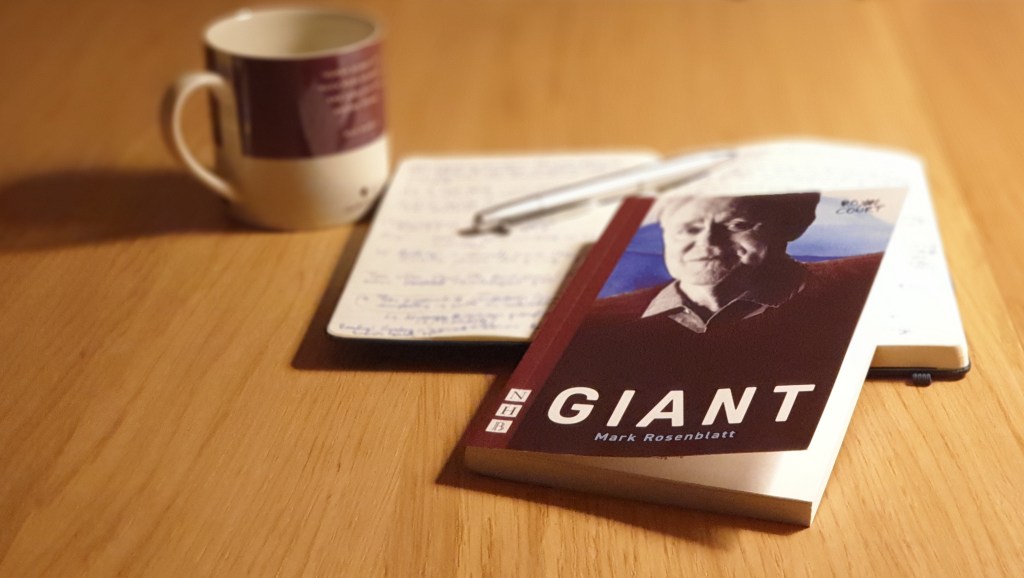
How can art tackle the huge, intractable and infinitely complex issues that bedevil history, politics and society? Often taking a macro lens to one facet of something that feels vast and impossible to express in two hours of stage traffic can forge a story that feels both manageable and illuminating, using the personal as one small foothold on the path towards understanding. Giant is a play that achieves this with skillful dramatic construction and control over the difficult material of real life.
The play takes as its focus one afternoon in the life of author Roald Dahl as he prepares for the publication of The Witches. More pressingly, he needs to manage the backlash from a review he has written of a book heavily critical of the 1982 Israeli invasion of Lebanon – a review that has been widely decried as antisemitic. Blending fact and fiction, Giant uses this incident to dramatise the sweeping complexity and interplay of morality and personality in this most contentious of global issues.
Structured around the rituals of food, eating and drinking and the power involved in hosting and being the host, the play’s action is nicely delineated. The setting of Dahl’s disrupted home under reconstruction creates a sense of order interrupted, security deferred, instability as part of daily life.
Dahl as presented in the play is cruel and compassionate, infantile and charismatic, domineering and needy, admirable and abhorrent. Around him whirl the frustrations and exigencies of people trying to find a way through ideological mazes: of Israel; the Jewish experience in history; a wildly successful artist’s irascible personality; and a way to simply get on and live their own lives. Tom Maschler, Holocaust survivor (a term he resists – “I was a boy. I got on a fucking train”) is Dahl’s British publisher. Dahl’s fiance is Liccy Crosland, forceful, independent, but seemingly using all her energies to manage Dahl. And the play’s fictional addition to the story is Jessie Stone, a Jewish American sent by his US publisher to make Dahl feel “flattered and fawned over” so he will acquiesce to a written apology for his antisemitism. Stone, placed in this compromised position, tries to challenge her bigoted and infuriating client, who is fully aware of the imbalance of power between them and uses it to his advantage and amusement as he throws counter punches at her viewpoint.
Rather than becoming a repetitive collection of political skirmishes, by grounding the conflicting perspectives in the psychology of its characters the play brings out the behavioural currents that drive history. The fading imperial English mindset, the US ascendancy, the immigrant experience, the workers who know their place. Rather than polemical mouthpieces, characters wrestle with – and are gradually drawn out of – their various positions, building to the thrilling cumulative admonishment that concludes the first act.
Moments of compassion give us a glimpse of why Dahl’s work endures. In amongst the horror and nastiness there is warmth and love that his characters cling to and strive for. A shared moment of understanding between Dahl and Stone speaks volumes about suffering and loss – which makes the ending of the play all the more powerful. We hope for some form of reconciliation or resolution, but what we see is a willful act of destruction: a deliberate cruelty and bigotry being a choice in order to wound. The antisemitism unleashed here becomes all the more shocking because of the mode of its expression.
Giant, appropriately, leaves us with a sense of foreboding; a storm on the horizon, that reminds us that over 40 years on from the events of the play, resolution is far from sight. One consolation offered is through the sharing of stories and through literature – regardless of who the teller of the story may be, and what they may or may not believe:
“You have to keep at them. Don’t let them slide. Keep at them. Reading! Reading is a great medicine! Builds the brain back up.”


Leave a Reply