
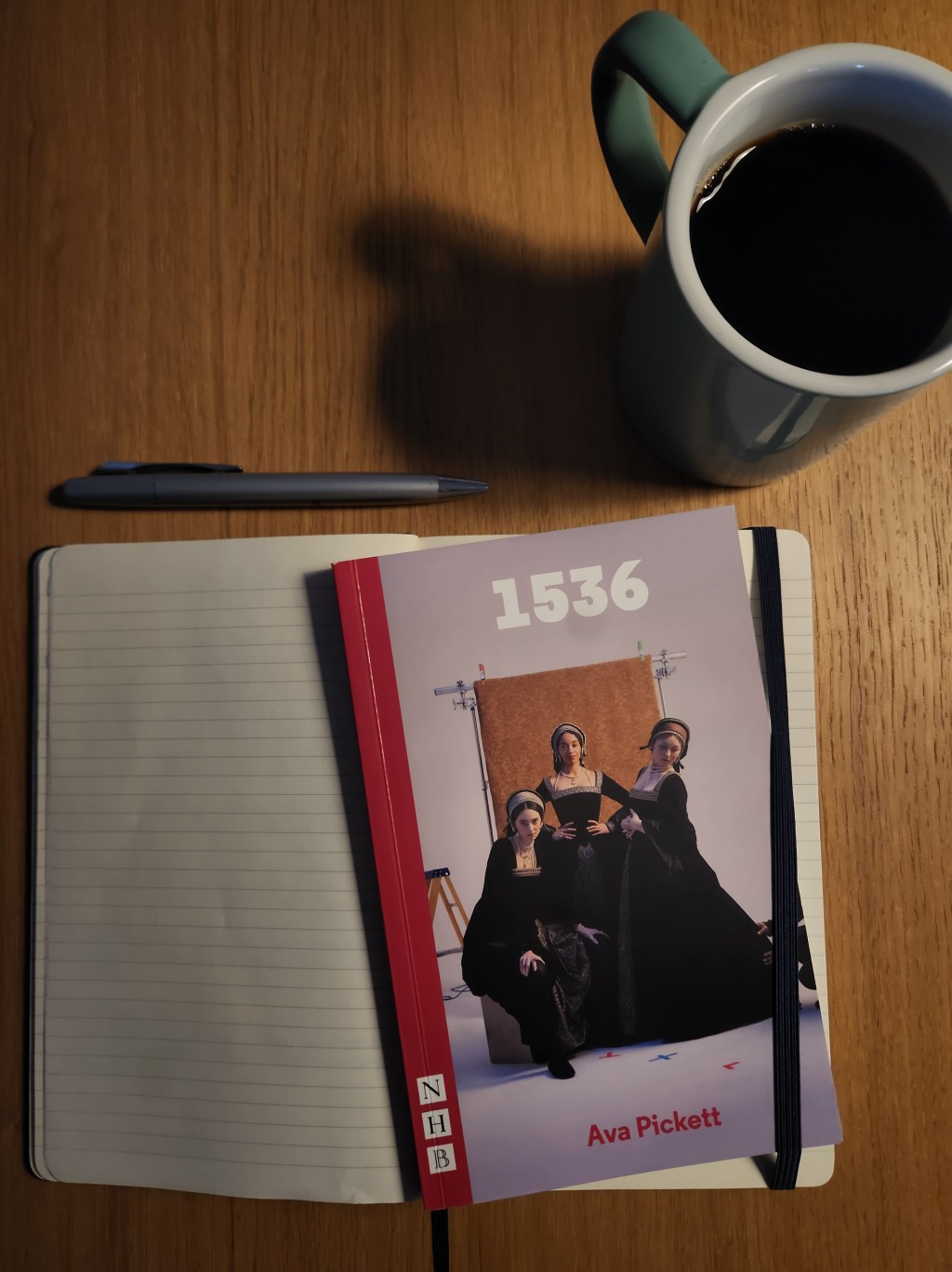
Three young women – Anna, Jane, and Mariella – work, play, enjoy their lives and their friendship. And they try to not be killed. Because the year is 1536 and King Henry VIII is about to have his queen Anne Boleyn executed, and this is a society where they have no power.
This premise is brought starkly, vividly and vibrantly to life in 1536, Ava Pickett’s debut play. Taking momentous historical moments and placing them on the periphery of the story is a potent way to analyse those moments; how they played out at the time and how they reflect and comment on the present day.
(Rona Munro’s Mary takes a similar approach in interrogating the execution of Mary Stuart through peripheral characters, both real and fictitious. Both these plays are great ways to begin unlocking history)
Across fifteen dynamic scenes female friendship is shown in all its complexity – love, loyalty, laughter but also anger, jealousy, selfishness and hate.
Anna lives her life leveraging what she perceives as sexual power over men. Jane is conventional, not sharp or witty, breathlessly excited by gossip and the prospect of marriage. Mariella is down to earth, hard working but at the mercy of her abnegated love for a man. These formative characteristics are put to the test as the play demands their response to the currents of history and society.
1536 is thrillingly rigorous in challenging its characters, their assumptions and the society they exist in. They speak in 21st century tones. There’s no cod-Tudor dialect. The language is of our time, transplanted back 500 years. The reality of life under oppression and violence is immediate. There is no linguistic safety filter that says this was then, so it can be neatly contained in a box marked “history”. History is a shadow – ominous and inevitable. We know how this story ends. In an irreverently profound exchange Anna demonstrates why the death of kings is an irrelevance:
JANE. What you’d be more worried if John Pollen the baker died instead of the King of England?
ANNA. Correct… when has the King ever given me a free loaf? Or a bun? Or a roll?
But the death of a queen endangers all of them. After news of the execution spreads, sounds of celebration begin:
JANE. They’ve kept the pubs open. The men are celebrating.
The play is full of witty, thunderous, haunting and horrifying lines. Tension is embedded in the structure of each scene, driving the play towards an inevitable conclusion. What is not inevitable is how the three choose to respond. Mariella has the play’s final line, one which can be interpreted through the multifarious lens of everything that has happened to these characters and the country. It’s a thrilling conclusion to a superb play.


Leave a Reply